
California operates one of the largest correctional systems in the United States, managing both state prisons and county jails under distinct administrative frameworks. The California Department of Corrections and Rehabilitation (CDCR) oversees 34 state prisons, housing over 95,000 inmates as of 2023, while 58 county jails—operated by local sheriffs—hold approximately 75,000 individuals awaiting trial or serving shorter sentences. This dual structure reflects California’s layered approach to incarceration: state prisons handle felony convictions with sentences longer than one year, while county jails manage misdemeanants, pretrial detainees, and those serving sentences under a year. The system has evolved significantly since the 1970s, when prison populations began rising sharply due to tough-on-crime policies, leading to chronic overcrowding and federal court oversight.
Overcrowding remains a defining challenge, despite reforms like Proposition 47 (2014) and AB 109 (2011), which shifted low-level offenders from state prisons to county supervision. Conditions in facilities vary widely, with some institutions offering robust rehabilitation programs and others criticized for inadequate healthcare, violence, and understaffing. Inmate rights are protected under state and federal law, including access to medical care, legal materials, and visitation. However, systemic issues such as gang activity, mental health crises, and staffing shortages continue to impact safety and rehabilitation outcomes. Transparency and oversight are managed through entities like the Office of the Inspector General and court-appointed monitors, though accountability gaps persist.
California State Prisons Overview
California’s state prison system is administered by the CDCR and consists of 34 institutions spread across the state, ranging from minimum-security facilities to maximum-security complexes. These prisons house individuals convicted of felonies with sentences exceeding one year. The system includes specialized facilities such as reception centers for intake processing, women’s prisons, and institutions with enhanced security for high-risk inmates. Each prison operates under strict operational protocols, including classification systems that determine housing assignments based on behavior, gang affiliation, and medical needs.
Types of State Prisons
State prisons in California are categorized by security level and function. Security levels range from Level I (minimum custody) to Level IV (maximum custody), with each level dictating staffing ratios, inmate movement, and program access. Reception centers, such as the California Institution for Men Reception Center in Chino, process new inmates and conduct medical, psychological, and risk assessments. Some facilities, like Pelican Bay State Prison, operate Secure Housing Units (SHUs) for inmates deemed threats to institutional safety.
- Level I: Open dormitories, minimal fencing, work assignments outside secure perimeter.
- Level II: Perimeter fencing, controlled movement, and some vocational programs.
- Level III: Double-fenced compounds, restricted movement, limited program access.
- Level IV: Maximum security, single cells, 23-hour lockdowns for high-risk inmates.
Notable Facilities and Their Functions
Several prisons have gained national attention due to their history, size, or operational model. Folsom State Prison, operational since 1880, is one of the oldest and houses approximately 2,500 inmates. It is known for its vocational programs and historical significance, including Johnny Cash’s 1968 live concert. San Quentin State Prison, located in Marin County, is the state’s only death row for men and has a capacity of over 3,000. Despite ongoing debates about capital punishment, executions have been on hold since 2006 due to legal challenges.
| Prison Name | Location | Capacity | Security Level |
| San Quentin State Prison | Marin County | 3,082 | II, III, IV (Death Row) |
| Pelican Bay State Prison | Del Norte County | 2,800 | IV |
| Folsom State Prison | Sacramento County | 2,500 | II, III |
Inmate Population and Demographics
As of 2023, the CDCR reports an inmate population of 95,412, a decline from over 170,000 in 2006 due to sentencing reforms and realignment. The demographic breakdown shows a majority of inmates are male (93%), with racial disparities persisting: 31% are Hispanic, 29% are Black, 28% are White, and 12% identify as other or unknown. Age distribution indicates that 58% are between 25 and 44 years old, while 15% are over 55, reflecting an aging prison population. Chronic health conditions, including hypertension, diabetes, and mental illness, are prevalent, with 30% of inmates diagnosed with a mental health disorder.
California County Jails System
County jails in California are operated by local sheriff’s departments and serve multiple functions: housing pretrial detainees, holding individuals sentenced to less than one year, and processing arrests. Unlike state prisons, jails are short-term facilities with high turnover. As of 2023, the total jail population averages 75,000, though daily counts fluctuate due to arrests and releases. Overcrowding remains a critical issue, particularly in urban counties like Los Angeles and San Diego, where populations often exceed design capacity by 20–30%.
Jail Functions and Inmate Flow
Jails operate on a cycle of intake, classification, housing, and release. Upon arrest, individuals are brought to a jail for booking, which includes fingerprinting, photographing, medical screening, and background checks. Classification determines housing based on charge severity, behavior history, and medical needs. Pretrial detainees—those awaiting trial—comprise about 65% of the jail population, while the remainder are serving sentences or held for other reasons such as immigration holds.
- Arrest and transport to a jail facility.
- Booking: Name, charge, photo, fingerprints, and medical screening recorded.
- Classification: Risk assessment determines the housing unit.
- Housing assignment in the general population, segregation, or a medical unit.
- Court appearance, release, or transfer to state prison if convicted of a felony.
Major County Jails and Capacity
Los Angeles County operates the largest jail system in the nation, with the Twin Towers Correctional Facility and Men’s Central Jail housing over 15,000 inmates combined. The Los Angeles County Clerk maintains various public records connected to county legal and administrative services. San Diego County Jail, with a capacity of 4,200, and Alameda County’s Santa Rita Jail (3,800 beds) are among the largest. Many jails face criticism for poor conditions, including inadequate medical care and the use of solitary confinement. In 2022, Santa Rita Jail reported 12 in-custody deaths, prompting state investigations.
| Jail Name | County | Capacity | Primary Function |
| Men’s Central Jail | Los Angeles | 4,600 | Pretrial, short-term sentences |
| Santa Rita Jail | Alameda | 3,800 | Pretrial, medical housing |
| San Diego Central Jail | San Diego | 2,200 | Intake, classification |
Jail Overcrowding and Alternatives
Overcrowding in county jails stems from pretrial detention policies, lack of mental health services, and limited alternatives to incarceration. To address this, counties have implemented diversion programs, electronic monitoring, and supervised release. For example, San Francisco’s Behavioral Health Court allows nonviolent offenders with mental illness to receive treatment instead of jail time. Despite these efforts, many jails remain over capacity, leading to double-bunking and reduced program access.
California Inmate Search Tools
To locate an inmate in California, the public can use the California Department of Corrections and Rehabilitation (CDCR) system for state prisons or county jail databases for local custody records. These systems provide information such as custody status, facility location, housing assignment, and projected release dates.
CDCR Inmate Search: State Prison Records
The California Department of Corrections and Rehabilitation maintains the official inmate information system for individuals housed in state prisons.
- https://www.cdcr.ca.gov/
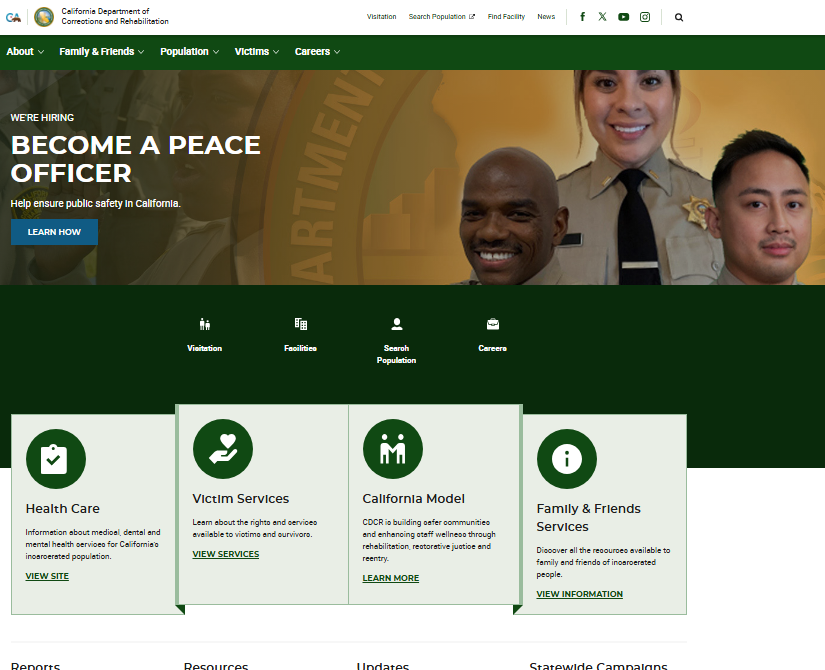
- From the homepage, navigate to:
Offender Information → Inmate/Offender Search
Search Process
- Enter the inmate’s last name
- Optionally add first name or initials
- Or enter the CDCR number if available
- Click Search
Results May Include
- Inmate name
- CDCR number
- Current prison facility
- Custody status
- Parole eligibility date
- Projected release date
Los Angeles County Inmate Search
The Los Angeles County Sheriff’s Department provides inmate custody information through its official custody services system.
- https://lasd.org/

- Navigate to:
Custody Services → Inmate Information Center
Search Results May Include
- Booking number
- Charges
- Bail amount
- Housing location
- Scheduled court date
San Diego County Inmate Search
The San Diego County Sheriff’s Office provides jail and inmate custody information through its official website.
- https://www.sdsheriff.gov/#Top

- Navigate to:
Jails → Inmate Information / Inmate Lookup
Available Information
- Inmate name
- Booking details
- Charges
- Custody location
- Court information
Limitations and Accuracy
Online inmate databases may not update instantly. Transfers, releases, and newly processed inmates may take several hours or days to appear. Some records may also be restricted for legal or security reasons.
California Prison Conditions and Reforms
Prison conditions in California have been shaped by decades of litigation, legislative reforms, and advocacy. Federal court oversight, initiated in 1990 due to overcrowding and inadequate healthcare, led to population caps and improved medical services. Despite progress, challenges remain in areas such as mental health care, use of solitary confinement, and staff-inmate ratios.
Healthcare and Mental Health Services
The CDCR provides medical, dental, and mental health care through the California Correctional Health Care Services (CCHCS). Inmates receive screenings upon intake and ongoing treatment for chronic conditions. Mental health services include crisis intervention, therapy, and medication management. However, staffing shortages and high caseloads limit effectiveness. In 2022, the average psychiatrist-to-inmate ratio was 1:400 in some facilities.
- Intake medical screening within 14 days of arrival.
- Access to primary care physicians and specialists.
- Psychiatric evaluations for inmates with behavioral issues.
- Medication-assisted treatment (MAT) for opioid use disorder.
Use of Solitary Confinement and Reform Efforts
Solitary confinement, or segregated housing, is used for disciplinary reasons, protective custody, or gang management. Critics argue it exacerbates mental illness and violates human rights. In 2015, CDCR agreed to limit solitary confinement for inmates with serious mental illness under a court settlement. As of 2023, inmates cannot be held in segregation for more than 15 consecutive days unless reviewed by a mental health professional.
Recent Reforms and Legislative Actions
Recent reforms include Senate Bill 132 (2021), which allows inmates to request housing based on gender identity, and Assembly Bill 280 (2023), which expands access to gender-affirming care. Proposition 57 (2016) increased parole opportunities for nonviolent offenders and incentivized rehabilitation program participation. These changes reflect a shift toward reducing incarceration and improving reentry outcomes.
California Inmate Rights and Legal Protections
Inmates in California retain certain constitutional rights, including access to courts, medical care, and freedom from cruel and unusual punishment. These rights are enforced through internal grievance procedures, civil lawsuits, and oversight bodies. Violations can result in disciplinary action against staff or policy changes.
Access to Courts and Legal Resources
Inmates have the right to file lawsuits, habeas corpus petitions, and appeals. Each prison provides a law library with computers, legal forms, and access to case law. The CDCR’s Legal Affairs Division processes inmate legal mail and ensures timely delivery. Inmates may also request assistance from prison legal advocates or outside attorneys.
Visitation Rights and Communication
Visitation is permitted based on facility rules, typically on weekends and holidays. Inmates may have up to six approved visitors, including family and attorneys. Visits are non-contact in most facilities, conducted through glass partitions. Communication via mail, phone, and email is allowed, though monitored. Phone calls are collect or prepaid through approved vendors like Global Tel*Link.
Protection from Abuse and Discrimination
The Prison Rape Elimination Act (PREA) mandates reporting and investigation of sexual abuse. CDCR trains staff and inmates on prevention and response. Inmates can report abuse anonymously through the PREA hotline. Discrimination based on race, religion, or disability is prohibited under state and federal law, with complaints reviewed by the Office of Internal Affairs.
California Parole and Reentry Programs
The parole system in California allows eligible inmates to serve the remainder of their sentence in the community under supervision. Parole decisions are made by the Board of Parole Hearings, which evaluates risk, rehabilitation, and public safety. Reentry programs aim to reduce recidivism through housing, employment, and counseling support.
Parole Eligibility and Hearing Process
Inmates serving life sentences with the possibility of parole become eligible after serving their minimum term (e.g., 15 years for second-degree murder). The parole board conducts hearings every 1–15 years, depending on prior decisions. At the hearing, the board reviews the inmate’s record, victim statements, and psychological evaluations. If denied, the inmate receives a denial period of 3, 5, 7, 10, or 15 years.
Reentry and Transitional Programs
The CDCR operates reentry hubs in cities like Los Angeles, San Diego, and Sacramento. These centers provide job training, housing assistance, and substance abuse counseling. The Male Community Reentry Program (MCRP) allows eligible inmates to serve the final 12–24 months of their sentence in a community facility. Women’s programs emphasize trauma-informed care and family reunification.
Recidivism and Program Effectiveness
California’s three-year recidivism rate is approximately 45%, meaning nearly half of released inmates return to prison within three years. Programs that reduce recidivism include vocational training (e.g., welding, carpentry), cognitive behavioral therapy, and post-release supervision. Inmates who complete education programs are 43% less likely to reoffend.
California Prison Staffing and Oversight
Staffing shortages and accountability are ongoing concerns in California’s correctional system. The CDCR employs over 30,000 correctional officers, counselors, and medical staff. However, vacancy rates exceed 10% in some facilities, leading to overtime and burnout. Oversight is conducted by multiple agencies to ensure compliance with laws and regulations.
Staff Roles and Training
Correctional officers are responsible for security, inmate supervision, and emergency response. They undergo 16 weeks of training at the CDCR Academy, covering use of force, ethics, and crisis intervention. Medical staff includes nurses, doctors, and mental health professionals, many of whom work under contract with CCHCS. Training is ongoing, with annual recertification required.
Oversight Agencies and Accountability
The Office of the Inspector General (OIG) conducts independent audits and investigations of CDCR operations. The OIG publishes annual reports on use of force, medical care, and staffing. Additionally, the federal court-appointed Receiver for Medical Care monitors healthcare delivery. County jails are overseen by the Board of State and Community Corrections (BSCC), which sets standards and conducts inspections.
Use of Force and Incident Reporting
Use of force is governed by CDCR policy 52050.01, which requires documentation and review of all incidents. Officers must report any physical intervention, including restraints or chemical agents. Incidents are reviewed by internal affairs and may result in disciplinary action. Data on use of force is published quarterly on the CDCR website.
California Prison Education and Rehabilitation Programs
Education and rehabilitation are central to reducing recidivism and preparing inmates for reintegration. California offers a range of academic, vocational, and therapeutic programs, many accredited and recognized by external agencies.
Academic and Vocational Training
All 34 state prisons operate accredited schools under the Office of Correctional Education. Programs include GED preparation, adult basic education, and English as a Second Language (ESL). Vocational training covers fields such as automotive repair, culinary arts, and computer coding. At Folsom Prison, inmates grow over 400 pounds of vegetables annually for local zoos through a horticulture program.
- GED completion rate: 68% among participants.
- Vocational certification in 12 trades.
- Partnerships with community colleges for college credits.
Substance Abuse and Mental Health Programs
The Office of Substance Abuse Treatment Services (OSATS) provides a 90-day intensive program for male inmates, replacing longer models due to budget constraints. Women’s programs focus on trauma recovery and peer counseling. Mental health services include group therapy, medication management, and crisis intervention. Inmates with co-occurring disorders receive integrated treatment.
Rehabilitation and Reentry Initiatives
Rehabilitation extends beyond incarceration. The CDCR partners with nonprofits to provide job placement, housing, and mentorship. The Returning Home Program helps inmates secure identification, Social Security cards, and transitional housing. Inmates who participate in rehabilitation programs are 30% less likely to return to prison.
California Prison Budget and Funding
The CDCR’s annual budget exceeds $14 billion, making it one of the largest state agency expenditures. Funding supports operations, healthcare, staffing, and rehabilitation. County jails receive funding from local budgets and state grants, often leading to disparities in resources.
State Prison Expenditures
In 2023, the CDCR allocated $8.2 billion to operations, $3.1 billion to healthcare, and $2.7 billion to staffing. Per-inmate cost averages $81,000 annually, driven by medical care and security. Budget increases have focused on mental health services and staff recruitment.
County Jail Funding and Challenges
County jails rely on local property taxes and state realignment funds. Los Angeles County spends over $1 billion annually on its jail system. Many counties face funding shortfalls, limiting program expansion and facility maintenance.
Private Prisons and Contracting
California does not operate private prisons within the state but contracts with out-of-state facilities to house inmates. As of 2023, approximately 2,000 inmates are housed in private prisons in Arizona and Oklahoma. These contracts are reviewed annually and subject to legislative approval.
| Agency | Address | Phone | Hours |
| California Department of Corrections and Rehabilitation | 1501 Capitol Avenue, Sacramento, CA 95814 | (916) 324-5999 | Monday–Friday, 8:00 AM – 5:00 PM |
(FAQs) About California Prisons and Jails
California’s prison and jail system can be complex, with different rules, agencies, and procedures depending on the facility and custody level. The following FAQs provide clear, practical answers to common questions about locating inmates, visitation rules, healthcare, parole hearings, and rehabilitation programs within California correctional facilities.
How do I find out if someone is in a California state prison?
Use the CDCR Inmate Locator at https://cdcr.ca.gov/. Enter the inmate’s 7-digit CDCR number in the first field or their full name in the second and third fields. Click “Search.” The system returns the inmate’s name, CDCR number, current prison, housing unit, and projected release date. If no record appears, the person may be in the county jail or released. For county jails, visit the local sheriff’s website and use their inmate search tool, which typically requires a name or booking number.
What are the visitation rules for California prisons?
Visitation policies vary by facility, but generally allow visits on weekends and holidays. Inmates may have up to six approved visitors, including family and attorneys. Visits are non-contact, conducted through glass partitions, and last 2–3 hours. Visitors must present a valid ID and pass a background check. Minors under 18 require parental consent. Some prisons offer video visitation as an alternative. Scheduling is done online through the CDCR’s visitation portal or by calling the facility. Failure to follow rules may result in suspension of visitation privileges.
Can inmates in California receive medical care?
Yes, all inmates have a constitutional right to medical care under the Eighth Amendment. Upon intake, they receive a medical screening within 14 days. Ongoing care includes treatment for chronic conditions, mental health services, and emergency care. The California Correctional Health Care Services (CCHCS) manages healthcare delivery. Inmates can request medical attention through sick call slips. However, delays and staffing shortages can affect access. Serious conditions are referred to outside hospitals. Inmates with mental illness receive evaluations and treatment, including medication and therapy.
What happens during a parole hearing in California?
Parole hearings are conducted by the Board of Parole Hearings for inmates serving life sentences with the possibility of parole. The inmate appears before a panel, which reviews their criminal history, behavior in prison, program participation, and psychological evaluations. The victim or their family may submit a statement. The board decides whether the inmate is suitable for parole or denies it for 3, 5, 7, 10, or 15 years. If denied, the inmate receives a written explanation and can reapply after the set period. The decision is based on public safety, rehabilitation, and the nature of the crime.
Are there education programs in California prisons?
Yes, all 34 state prisons offer accredited education programs through the Office of Correctional Education. These include GED preparation, adult basic education, English as a Second Language (ESL), and vocational training in fields like welding, carpentry, and computer skills. Programs are accredited by the Western Association of Schools and Colleges. Inmates can earn certificates and, in some cases, college credits through partnerships with community colleges. Participation is voluntary and based on eligibility. Studies show that inmates who complete education programs are significantly less likely to reoffend.